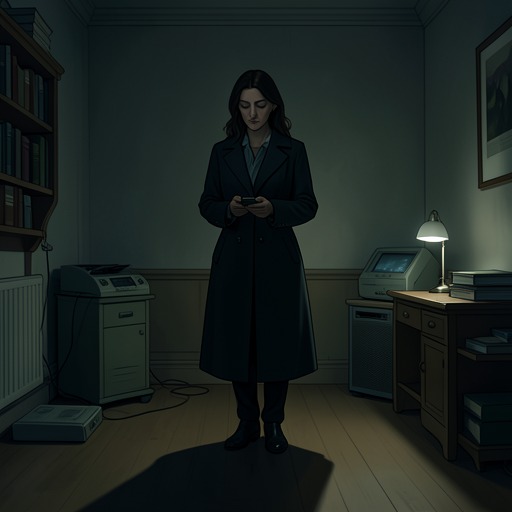
Maya's gun safe
Fool Me OnceMaya's gun safe first appears to be a practical safeguard: secured by Maya Stern's fingerprint, stocked with weapons she checks and cleans, and organized so that its registered firearms can be accounted for. But the safe also has a concealed compartment, and one firearm kept there becomes the clue that changes how Maya Stern understands her sister's murder. Its significance lies in that double function. It protects weapons from unauthorized access while preserving evidence of who may have accessed and used them.
Design, Access, and Routine
The safe stands in the basement of Maya Stern's home, a room that Joe Burkett had gradually been changing from an upscale retreat into a playroom for Lily. The transformation is visible in its white walls, character decals, and indoor playhouse, while remnants of the older basement remain. In this domestic setting, the safe is a deliberately controlled space within a room being remade for a child: weapon storage and family life occupy the same basement, but the weapons are meant to stay secured.
Access depends on a fingerprint reader. The safe can store thirty-two fingerprints, yet only Maya Stern and Joe Burkett have been enrolled. Maya Stern had considered adding Shane's print, so that he could retrieve one of her weapons if needed, but had not done so. Two clicks confirm that her own fingerprint is recognized and the safe unlocks. The small mechanical sequence makes entry legible: the safe records a narrow circle of authorized access, even though its capacity would allow that circle to be larger.
Maya Stern's handling of the contents is methodical. She takes out a Glock 26 and checks the remaining guns to make sure none is missing. Then she inspects and cleans the weapons one by one, despite having done so recently. The repeated procedure is not casual maintenance: she rechecks a gun each time she touches it, a habit she believes may have saved her life. The safe's inventory and condition therefore matter to her as much as its lock. A weapon's absence, or a change in its state, can register against a baseline she has personally established.
The Concealed Compartment
The weapons visible in the safe are the ones registered in New Jersey, and their presence confirms that the openly stored inventory is intact. Maya Stern then reaches to the back, presses a concealed spot, and finds a secret compartment. It contains two guns bought out of state, which she understands to be untraceable to her, though she regards their possession as legal. The arrangement separates a public-facing inventory from a hidden reserve: the guns she has shown Roger Kierce are present, but they are not the whole collection.
The compartment connects Maya Stern's present household to a family practice. Finding it makes her think of her grandmother's trunk at Claire Walker's house, where a false wall and hidden space carried a tradition that began generations earlier in Kiev. The concealment is thus more than an isolated security feature. It repeats a method of hiding across generations and places, now reproduced by Maya Stern in her own home. That inheritance does not itself identify who has touched the guns, but it gives the safe a private history that contrasts with the ordinary, visible weapons above it.
At this point, Maya Stern is uncertain about the possibility that Joe Burkett is alive. She does not believe it, but cannot dismiss it completely. Her inspection of the hidden guns tests that fear against the facts available to her: both are still there. The passage briefly plays with the idea of a ghost who could not leave fingerprints or open the safe, but the practical question remains who could have entered it and what they might have taken. The safe's physical limits bring an eerie suspicion back to the concrete problem of access.
The Clue That Reframes the Murder
In retrospect, opening the safe is the moment that changes everything. Maya Stern is meticulous about keeping her guns clean, and when she takes out the Smith & Wesson 686 revolver from the hidden compartment, she recognizes that it has been used. More specifically, she sees that someone unfamiliar with the weapon has tried to clean it. The altered condition stands out because it violates the routine she has followed every time she handles a gun.
That observation revises earlier details about Joe Burkett. After returning home, he had stressed his dislike of guns, his lack of interest in going to the range with Maya Stern, and his wish that she would not keep firearms in the house. Yet he had also asked to have his fingerprint stored in the safe, explaining that it was for just in case. In retrospect, the safe makes that request difficult to treat as harmless. The contrast between his stated aversion to guns and his authorized access becomes part of the inference Maya Stern forms from the disturbed weapon.
Maya Stern initially allows for another explanation: perhaps a clever hit man had broken in, used the gun, and returned it. She does not immediately treat her conclusion as beyond doubt. To test it while limiting access to the other weapons, she switches the two Smith & Wesson 686 revolvers, moving the one Joe Burkett had taken from the hidden compartment into the visible, New Jersey-registered position. She also ensures that the other guns are unloaded or separated from their ammunition. The safe becomes an instrument of investigation: its arrangement is changed so that a future interaction with the weapons may expose what Joe Burkett knows or does.
From Storage to Evidence
The weapon's condition gives Maya Stern a conclusion before she has completed the checks that might substantiate it. She knows, even while resisting the knowledge, that her own gun killed Claire Walker. She later goes to the range, fires the weapon, and brings a bullet to Shane for a secret comparison with the .38 found in Claire Walker's skull. That sequence confirms the importance of the safe without making its evidence self-sufficient: the safe reveals a gun has been used and altered; further testing connects it to the fatal bullet.
Maya Stern also searches through Joe Burkett's belongings and intentionally leaves signs that she has done so. She wants him to understand that she is onto him, to watch for his reaction, and to obtain enough information to make him explain why he killed Claire Walker. The safe's discovery therefore leads directly to a deliberate confrontation rather than an immediate accusation based only on suspicion. The later understanding that Maya Stern, not Joe Burkett, called him that night follows from this investigative choice; she tells him that she knows what he did.
As an object, Maya's gun safe is not simply a container whose contents happen to matter. Its fingerprint system defines authorized access; its inventory makes absence detectable; its hidden compartment keeps a second, less visible set of weapons; and its routine of inspection makes an unfamiliar cleaning attempt conspicuous. The safe turns habits of security into a form of evidence. What had seemed to be a locked, orderly household object becomes the place where Maya Stern's careful knowledge of her guns exposes a betrayal within her marriage and redirects her search for the truth about Claire Walker.